Roman villa quest
Two scouting expeditions, more to come

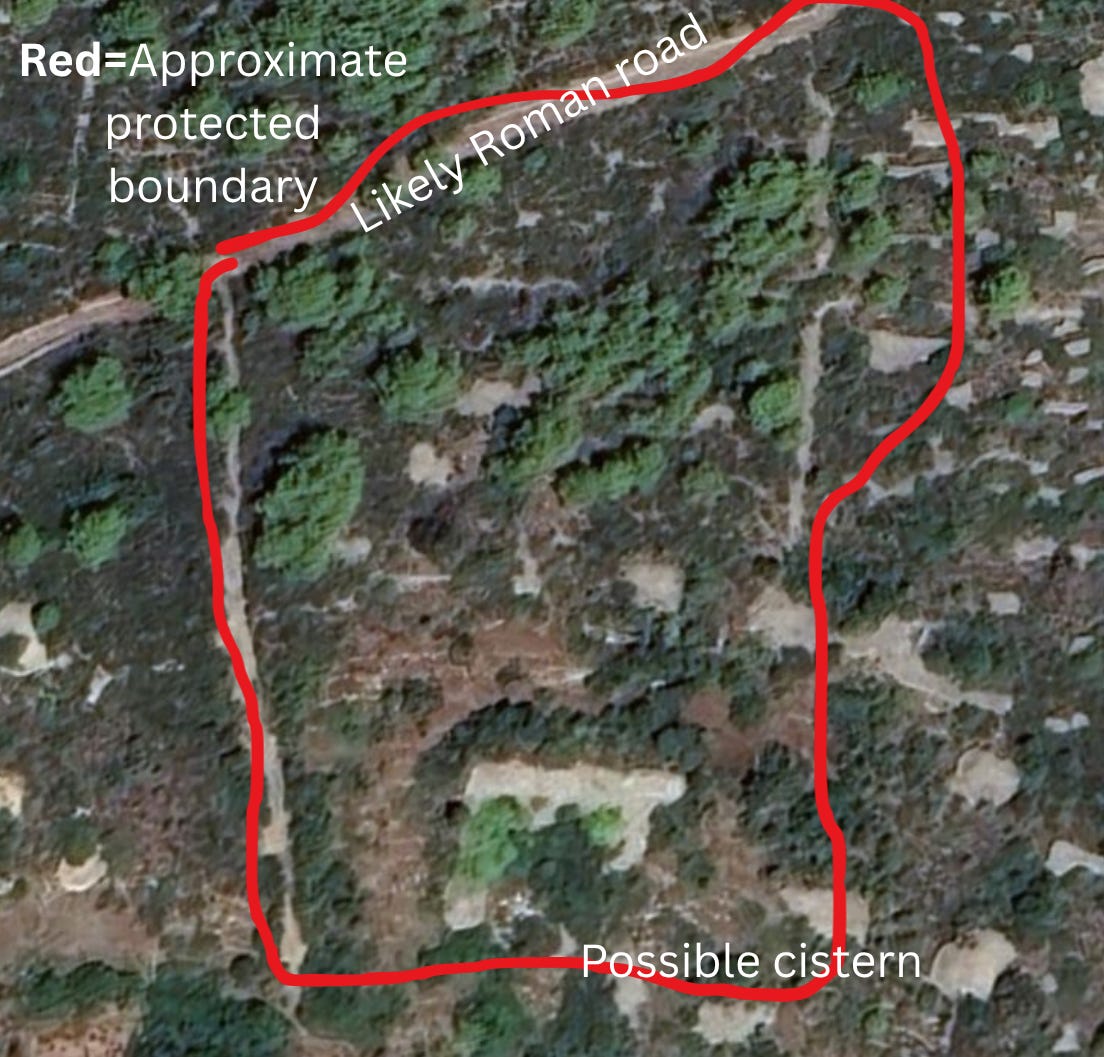
One of the things on my long-term “to do” list is to make an English Wikipedia page for our village of Podhumlje. I want to do this for many reasons, but mostly because the Croatian Wikipedia page for Podhumlje1 lists a mysterious landmark: the Bačokovo archaeological site.2
Sasha and I first read the Bačokovo page a few years ago, but it was only a couple of weeks ago that we decided to hike to Bačokovo to see if we could find any visible remnants of the Roman villa rustica3 (agricultural complex) built between 200-400 AD that are supposed to be there.
During our first visit, turns out we were exactly in the correct place, but we couldn’t find anything from the Bačokovo Wikipedia page, even scrambling through the overgrown brush. Of course, we forgot to take pictures. So we did a second hike, in the wrong place by mistake. But because of this, we stumbled upon the likely old Roman road that led to the villa compound (satellite image above, top).
Undaunted (and inspired by the large road!), we returned home and read a bit more about the site. We found the parcel numbers for Bačokovo, which belong to the town of Komiža, in the online Croatian real estate information system (Katastar) and scanned Google Earth’s satellite pictures and 3D visualizations. The parcels (approximate boundaries, red, in screenshot above) exactly matched the information on the Wikipedia page, even extending to the road we’d found on our second visit. And interestingly, two long walls leading down the hill from the road correspond, in large part, to the parcel boundaries (!).
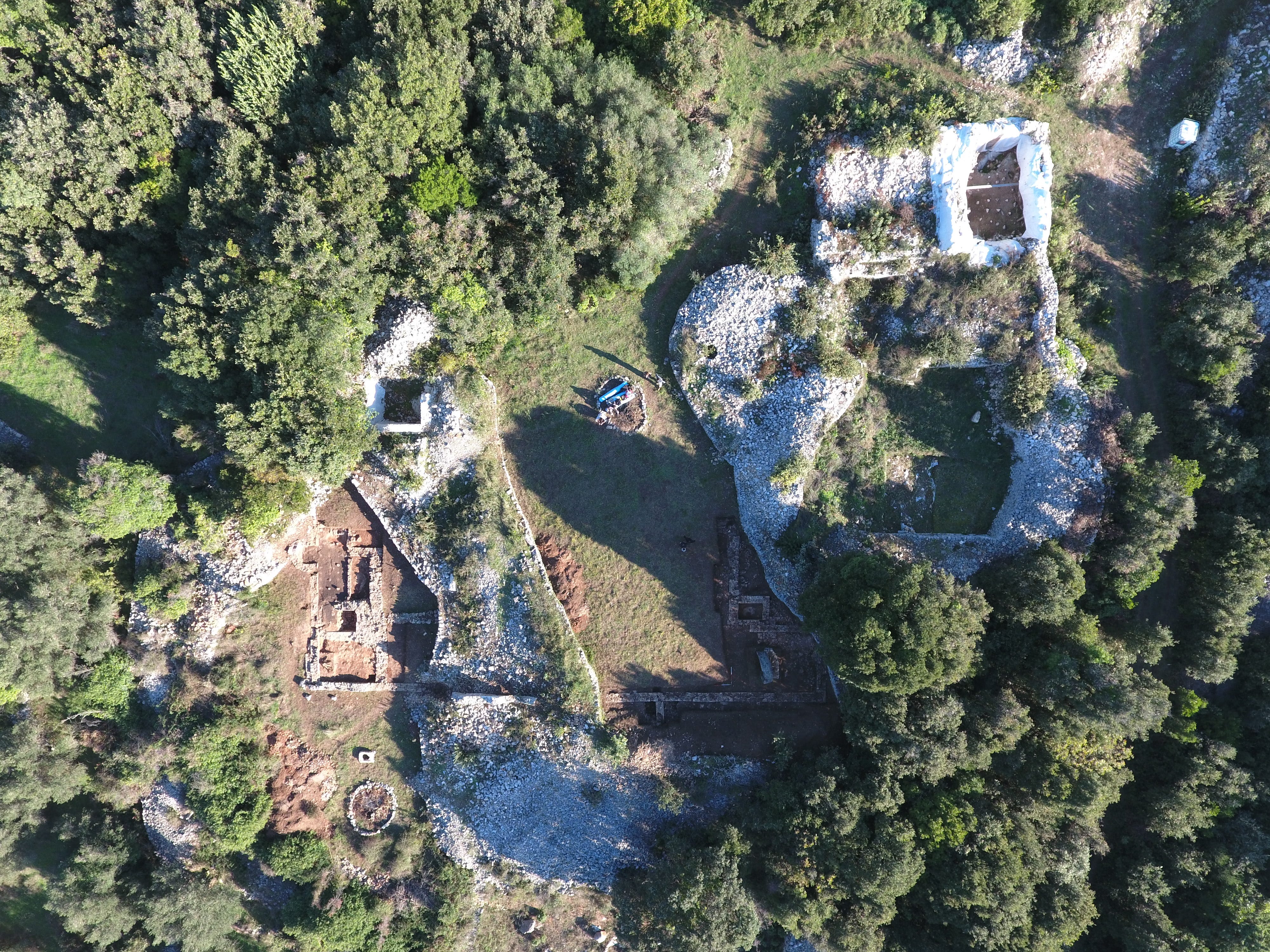
For our next expedition, we plan to bring trimmers to better make our way through the brush. I’ll talk about it in future posts. We’re determined to find at least something from this Roman complex, though we might fail. If it’s ever excavated, one could imagine it might resemble the Bunje site on the nearby island of Brač4:
https://hr.wikipedia.org/wiki/Ba%C4%8Dokovo_(arheolo%C5%A1ko_nalazi%C5%A1te). The content of this page is based on the Republic of Croatia’s Ministry of Culture and Media’s official heritage listing, https://registar.kulturnadobra.hr/#/details/Z-5825. Google Translate’s literal translation of description: “At the Bačokovo site in Podhumje, about 300 m north of a parish hall and chapel, there are the remains of a Roman villa rustica. The remains of a wall built of regular stone blocks (medium-sized, with the use of plaster, about 50 cm high) are visible. A black and white mosaic with a threshold has been preserved next to the wall, connecting two rooms. Along with this black and white mosaic, the cubes of which are irregular and larger in size, the remains of a polychrome mosaic have also been found. In the immediate vicinity, there is a field shack with an ancient threshold incorporated. A fragment of a column has also been preserved, and in the immediate vicinity, there are numerous fragments of ancient ceramics and worked stone blocks. From this, it follows that the villa rustica in Bačokovo belongs to the type of numerous villas located along fertile fields on the central Dalmatian islands, and due to the degree of preservation and particularly valuable mosaics, it has the status of a cultural property.”
You are doing real archaeological research. Not quite what you trained to do at UM SI, but why not? This is interesting!